Deciding to try couples and relationship therapy takes courage. What comes next – the research, the logistics, the questions about what therapy will actually feel like – can add another layer of uncertainty. One of the most common things couples ask us is whether online or in-person sessions will be more effective. Is online therapy as effective as in person? The honest answer: the research says they produce comparable outcomes. So the question is not which format wins. It is which one fits your relationship, your life, and what you are carrying right now.
This article draws on clinical experience working with couples and relationships in both formats, and on the research that compares them. Our hope is that by the end of it, the decision feels clearer – not because we have prescribed an answer, but because you have a better sense of what each format actually asks of you, and what it offers in return.
The Research: What the Evidence Actually Shows
The evidence is genuinely reassuring. A 2021 meta-analysis of 4,336 clients by Idit Sharoni found that online and in-person therapeutic interventions produced broadly equivalent outcomes across a range of presenting issues, including relationship difficulties. Therapeutic alliance – the quality of connection between therapist and client – was similarly strong in both formats. This is an important finding. It means the relational bond at the heart of therapy, which is where the real work happens, can be built just as meaningfully through a screen.
More recently, a 2024 study by Johnson et al. found that therapeutic alliance built approximately twice as fast in face-to-face sessions. This matters. If you are in crisis – if the relationship is genuinely at a tipping point – faster trust means faster access to the deeper work. That is not a small thing.
The takeaway is not that one format wins. When it comes to online therapy vs in person, the evidence says both can work. The format you actually attend – consistently, honestly, and with genuine commitment – will outperform the theoretically better one you struggle to show up for.
How Does Online Couples Therapy Work?
Online couples therapy is now clinically established and widely available. Sessions take place over a secure video platform: Zoom, Microsoft Teams, or a dedicated therapy application. Both partners typically join from the same room, though occasionally from separate locations when partners travel or work in different cities. The therapist leads the session as they would in person – exploring what is alive between partners, facilitating difficult conversations, and introducing exercises or reflection prompts as the work develops. Sessions are usually 50 to 60 minutes, with a regular weekly rhythm that creates the conditions for something to shift.

The Practical Advantages of Online Couples Therapy
Convenience and access: The most obvious benefit is that there is no commute. For couples with young children, demanding jobs, or partners who travel frequently, removing the travel burden can be the difference between therapy happening and therapy not happening at all. Consistency is what makes therapy work, and in our experience, couples who could never have sustained weekly in-person appointments show up reliably online. Online also opens the therapist pool considerably. Rather than being limited by geography, you can choose someone based on their specific specialism: psychosexual therapy, emotionally focused therapy, LGBTQIA+ affirming practice, or working with neurodivergent couples.
Privacy and reduced stigma: For couples in small communities, tight-knit professional circles, or public-facing roles, attending a therapy practice in person can feel exposing before the session has even begun. Online removes that anxiety entirely. This matters particularly for queer couples in more conservative areas, where the act of seeking couples therapy can carry its own weight.
The comfort of familiar surroundings: Something our therapists notice regularly in online work is that the home environment can support the therapeutic process in ways that surprise people. One couple I work with are often joined by their cats – who settle between them on the sofa. Far from being a distraction, the presence of their animals has at times created a quiet moment of co-regulation that neither partner planned for. That does not happen in a consulting room. For couples where one or both partners is neurodivergent, the familiar sensory environment of home can reduce anxiety and allow for a quality of openness that might take longer to arrive in an unfamiliar setting.
The screen as buffer: For couples working through psychosexual concerns – erectile difficulties, painful sex, low desire, sexual trauma – the slight distance a screen creates can be genuinely useful. Discussing deeply private matters face to face with someone you have only just met asks a great deal of both partners. The screen offers a small but meaningful degree of psychological distance that can make it easier to speak honestly, particularly in the early sessions when the therapeutic relationship is still finding its shape.
What Are the Drawbacks of Online Couples Therapy?
The therapeutic frame is harder to hold: Therapy works better when it is properly boundaried. The therapeutic frame – the container within which the work takes place – is easier to establish in a neutral, dedicated space. At home, that container is harder to maintain. Joining a session in pyjamas, or with a glass of wine – these are more common than they might seem. The familiarity of home can make a session feel more like a conversation on the sofa than a structured therapeutic encounter. That informality, however comfortable, can work against depth. Good online practice involves contracting clearly from the outset: a private, quiet room, no alcohol, phones away. These are not arbitrary rules – they are what allows a session to function as therapy.
Non-verbal information is reduced: A video frame usually shows heads and shoulders. It does not show whether a foot is angled toward the door, or the micro-expressions that cross a face before the composed version arrives. Therapists who work somatically – attending to the body as much as to words – are working with partial information online. For some presentations, and particularly for couples where one partner carries a great deal of embodied tension, this matters.
Tech can disrupt the work: Connection drops, frozen video, dead batteries. The point is not that technology fails often – it is that when it does, it tends to fail at precisely the moments of most emotional vulnerability. Mid-disclosure. Mid-conflict. Mid-breakthrough. Even a minor glitch can break a thread of feeling that takes time to recover.
Privacy at home is not guaranteed: Home is not always more private than a therapist’s office. Children in the next room, thin walls, a housemate who comes home unexpectedly – these are real constraints. A couple who cannot speak freely cannot do the work that needs doing.
Safeguarding, high conflict, and domestic violence: This deserves more honest conversation than it typically gets. Online therapy makes it significantly harder to assess whether domestic violence or coercive control is present in a relationship. The signals a therapist would notice in a room are harder to read through a screen. A controlling partner may be sitting just outside the camera frame, monitoring what is said. Couples therapy is generally contraindicated where domestic violence is present. Online increases the risk that this goes undetected. For high-conflict couples, explicit contracting before the first session becomes essential: agreements about taking space, leaving the room if either partner becomes dysregulated, and how to signal distress. Any therapist offering online couples work carries a genuine responsibility to screen carefully and take safeguarding seriously.
In-Person Couples Therapy: What Actually Happens
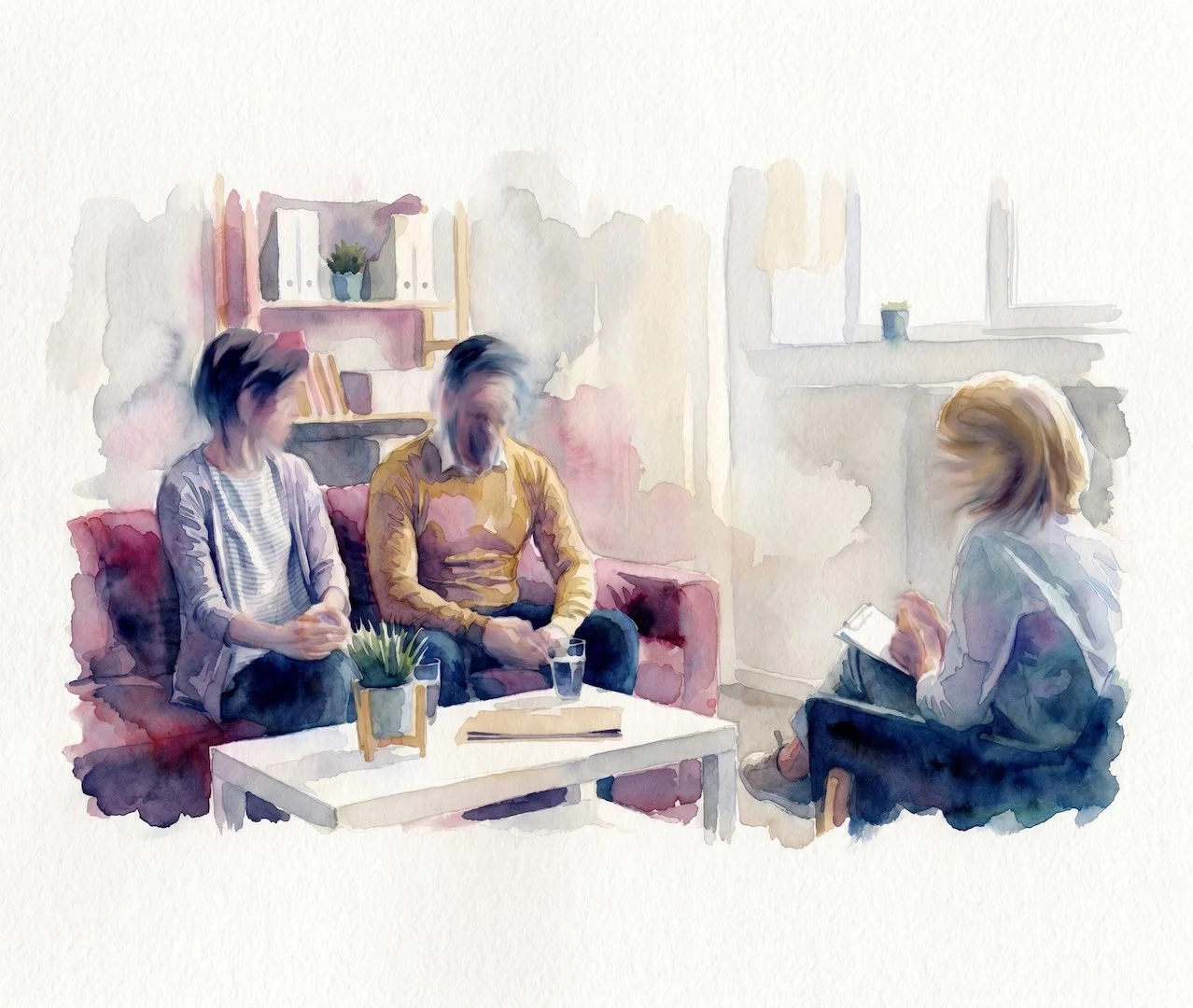
In-person sessions take place in the therapist’s consulting room – a neutral space that belongs to neither partner. Both sit facing the therapist, and often each other, in a setup the therapist can adjust as the session moves. Sessions typically run 50 to 60 minutes on a weekly basis, with a clear beginning and end that mark it as distinct from ordinary life. That boundary is not incidental. It is part of what makes the work possible.
What Are the Advantages of In-Person Couples Therapy?
Full access to the room, and the ability to use it: One of the most valuable aspects of working with couples in person is the ability to use physical space intentionally. A therapist can work with the distance and angle between partners – bringing them face to face when the work calls for it, creating more physical room when one partner needs to breathe. This kind of spatial attunement is simply not possible on a screen.
The felt sense of presence: Physical presence changes something. The felt sense of another human being in the room – their energy, their breathing, the way they hold tension in their body – is available in ways no screen can replicate. For experiential and Gestalt-informed work, for the moments where what the body is doing matters as much as what words are being said, the depth that is possible in person is meaningfully greater.
Therapeutic alliance builds faster: As Johnson et al. found in 2024, the bond between therapist and couple develops approximately twice as quickly face to face. For couples at a genuine tipping point, faster trust means faster access to the work that matters most.
Better containment of conflict: A skilled in-person therapist can contain escalation in ways that online simply does not allow. The room is a container. Physical stillness, pacing, eye contact, how the therapist positions themselves between partners – these are all part of how a session is held. For high-conflict couples, or those working through infidelity, trauma, or acute relational distress, this containment can be the difference between a session that opens something and one that simply spirals.
A natural transition out of the work: The commute to and from a session – often underestimated – functions as a transition ritual. You arrive having mentally prepared for what is ahead. You leave with space to process before returning to ordinary life. Closing a laptop and immediately starting dinner does not offer the same decompression. Couples who attend in person often find it easier to integrate what surfaces in sessions, to sit with what has been said rather than absorbing it immediately back into the noise of daily life.
The Practical Constraints of In-Person Couples Therapy
Logistics: Both partners need to be in the same place at the same time, every week. For couples with children, demanding travel schedules, or partners who work long or unpredictable hours, this is often the single biggest barrier to starting – and to sustaining – the work.
Geography limits choice: If you need a specialist in psychosexual therapy, non-monogamous relationships, or neurodivergent couples, your in-person options are shaped by what exists within a reasonable distance. In smaller cities and rural areas, that pool can be very limited.
Cost and waitlists: Online therapists do not carry the overhead of a consulting room, and this frequently shows in session fees. In-person fees are typically higher, and good couples therapists are often in demand with multi-week or multi-month waitlists – at a time when couples may need support now, not in three months.
Less resilient to life’s interruptions: Illness, a business trip, childcare falling through – any of these means cancelling an in-person session and losing momentum. Online sessions are more resilient to the ordinary disruptions of family life.
In-Person vs Online Couples Therapy: Key Differences
| Aspect | In-Person Therapy | Online Therapy |
| Therapeutic outcomes | Comparable | Comparable |
| Alliance-building speed | Faster | Slower initially |
| Non-verbal access | Full – body, posture, micro-expressions | Partial – head and shoulders only |
| Logistics | Both partners must travel, same time, weekly | Flexible – no commute, easier scheduling |
| Therapist choice | Limited by geography | Unrestricted – choose by specialism |
| Safeguarding | Easier to assess – therapist in the room | Requires extra care and pre-screening |
| Cost | Often higher – office overhead | Often lower |
| Experiential / somatic work | Deeper – felt sense, Gestalt exercises | More limited through a screen |
| Privacy from others at home | No concern – contained space | Requires genuinely private setup |
Bottom Line: Which Format Is Right for You?
So, is online therapy as effective as in person – and is in-person therapy better than online? The research says both formats work. The clinical reality, in our experience, is that the best format is the one you will actually attend – consistently, honestly, and with genuine commitment to the process.
Choose online if:
- Scheduling, travel, or finding a specialist are the main barriers to starting
- You have a private, quiet space at home and a reliable internet connection
- You are working on psychosexual or intimacy concerns and find it easier to open up with a degree of distance
- One or both partners is neurodivergent and finds a familiar sensory environment more regulating
Choose in-person if:
- Your conflicts escalate quickly and you need the containment of a physical space
- You do not have genuine privacy at home
- You are in acute distress and need the therapeutic relationship to build as quickly as possible
- You are working on somatic or experiential issues where physical presence matters
- You know from experience that you engage more deeply when someone is physically in the room with you
Consider a hybrid approach: an intensive in-person start – the first four to six weeks – to build the therapeutic relationship and establish the frame, followed by ongoing online sessions for flexibility. This is a common and sensible approach that draws on the strengths of both formats.
At Intima Therapy, our COSRT-registered therapists offer both online and in-person sessions. We work with couples across a wide range of presentations – from relationship breakdown and communication difficulties to psychosexual concerns, intimacy after children, infidelity, and neurodivergent relationships. If you are unsure which format is right for you, our free introductory call is the place to begin that conversation.
FAQs
Can I get couples therapy online or only in person?
At Intima Therapy, we offer both online and in-person couples therapy. Our online couples counselling sessions are available to couples across the UK through secure video sessions, while in-person therapy is currently available in London and Brighton.
Is in person therapy better than online?
Research consistently shows that outcomes are broadly comparable across both formats. What matters most is not the format itself but the quality of the therapeutic relationship and the consistency of your attendance. The therapy you commit to is the therapy that works.
Is online couples therapy private and secure?
Sessions should take place over a secure and encrypted platform. The bigger privacy question is usually your home setup – a genuinely private room, away from children or housemates, is essential for the work to happen openly.
Can we switch between online and in-person sessions?
Yes, and many couples do. Some start in person and move to online once the therapeutic relationship is established. Others mix formats depending on what each week allows. Discuss this with your therapist from the outset so expectations are clear.
Can online therapy provide the same level of emotional connection as in-person sessions?
For many couples, yes. For others – particularly those working on somatic issues, in high conflict, or early in the therapeutic relationship – the physical presence of a therapist creates a quality of connection and containment that a screen makes harder to replicate. It is worth being honest with yourself about which kind of support you need right now.
Which option is more flexible for busy couples?
Online, consistently. No travel, more flexible scheduling, and more resilient to the ordinary interruptions of family life. For couples where logistics are the main barrier to starting, online often removes that barrier almost entirely.
Is online therapy cheaper than in-person?
Often, yes – online therapists do not carry the overhead of a consulting room, and this frequently shows in lower session fees. That said, it is not universal. At Intima Therapy, we charge the same fee for online and in-person sessions – the decision is never about cost, only about what serves the work best.