The Illusion of the “Fairytale”
Have you ever experienced the “whirlwind” – that intoxicating sensation of finally finding the person you have been searching for your entire life?
At the beginning, everything feels effortless. Reciprocity seems natural, conversations flow, attraction is mutual, and the connection carries a dreamlike quality. For a few weeks or months, you inhabit a kind of emotional altitude where there is no doubt only certainty. It feels like arrival and that you are finally understood.
And yet, in many cases, this intensity does not signal stability, it precedes collapse. We often mistake the ‘impossible’ for the ‘extraordinary.’ We tell ourselves the connection is so rare that it’s worth the chaos, but usually, we are just using the drama to distract us from a much harder truth: we don’t yet believe we deserve a love that actually stays.
Reality begins to surface slowly at first. Small inconsistencies appear. Perhaps the other person mentions prior commitments, unresolved emotional entanglements, or logistical complications. They may be avoiding difficult conversations or hesitate when the topic of commitment arises. At first, these are easy to overlook. They can even feel like obstacles that deepen the bond – challenges that, once overcome, will prove the strength of the connection.
But over time, what was once easy begins to feel effortful. The reciprocity that seemed so natural becomes uneven as messages are delayed, plans become uncertain and emotional availability fluctuates. What once felt mutual now feels fragile and one-sided.
At some point, often gradually, sometimes abruptly, the realisation emerges: the relationship is, in fact, impossible.
Seeing Without Seeing: The Role of Compartmentalisation
Before this realisation fully takes hold, something else tends to happen. We begin to compartmentalise.
Compartmentalisation is a psychological defence mechanism that allows us to hold two conflicting realities at once without fully integrating them. On one level, we recognise the limitations of the relationship. On another, we continue to invest in the belief that it can still work.
Even when the other person is relatively honest about their situation, we filter what we hear. We hold onto the parts that align with our hopes and minimise the parts that threaten them. We tell ourselves that circumstances will change, that timing will improve, that emotional barriers will soften.
This is not simply denial. It is an attempt to preserve coherence to maintain the belief that the meaningful and rare relationship is not unattainable, even with its challenges.
But as the other person begins to withdraw emotionally, physically, or both, this internal balance becomes harder to sustain. Anxiety begins to replace the initial sense of calm. Sleep may be disrupted and thoughts become repetitive, looping around questions of meaning, intention, and self-worth.
These “impossible” relationships are not always dramatic. More often, they manifest as a quiet, persistent ache. They are sustained not only by the other person, but by hope, interpretation, and something deeper: a fragile sense of self-worth.
The Architecture of Low Self-Esteem
Self-worth (or self-esteem) is often confused with confidence, but the two are not the same. Confidence relates to what we believe we can do. Self-worth relates to what we believe we deserve.
It is a foundational psychological structure, typically formed early in life, shaped by how consistently we experienced care, attention, and emotional attunement by our primary caretakers. When self-worth develops in a stable environment – where care is relatively consistent and not contingent on performance – it provides a secure base for later relationships.
But what causes low self-esteem? When love is experienced as conditional – given more readily when we are compliant, helpful, successful, or emotionally undemanding – we begin to associate being lovable with providing value. Care is not something we receive freely; it is something we earn. This pattern then becomes embedded in how we relate to others.
Relationships shift from spaces of mutual exchange into something else. We may find ourselves over-functioning – adapting, accommodating, anticipating needs, and attempting to maintain connection through effort. In doing so, we unintentionally communicate something powerful: that the responsibility for sustaining the relationship lies primarily with us.
Over time, this creates an imbalance, leading to the other person not needing to invest equally because the structure of the relationship does not require it.
A person with diminished self-worth may unconsciously accept emotional scarcity because it aligns with their internal narrative. In this sense, the impossible relationship is not irrational – it is psychologically coherent, even as it remains deeply painful.
Why the “Impossible” Feels Familiar
Impossible relationships tend to share a recognisable anatomy: emotional unavailability, inconsistency, structural barriers such as distance or timing, and a noticeable asymmetry in emotional investment.
From the outside, these patterns can appear obvious. From the inside, however, they feel compelling, challenges we feel we could overcome.
This paradox can be understood through what psychology describes as repetition. We are not only drawn to what is good for us; we are drawn to what is familiar. If earlier experiences of attachment were marked by unpredictability, inconsistency, or emotional distance, then similar dynamics in adulthood can feel strangely “right.”
You may find yourself particularly activated in these relationships, thinking more, analysing more, trying harder. The emotional intensity can be mistaken for depth or significance. But often, it reflects activation rather than compatibility.
The relationship begins to function less as a meeting between two people in the present and more as a re-enactment of unresolved emotional patterns from the past.
Conversely, relationships that are stable, reciprocal, and emotionally available may initially feel unfamiliar or even underwhelming. Without the tension of uncertainty, they may lack the dramatic intensity that has come to feel like love.
The Role of Hope and Imagination
Impossible relationships are sustained not only by interaction, but by imagination.
We begin to relate not just to who the other person is, but to who they could be. Small moments of closeness are amplified, becoming evidence of potential. Extended periods of absence are rationalised – explained away by circumstances, stress, or misunderstanding.
A parallel version of the relationship emerges: one that exists partly in reality and partly in projection – and hope plays a central role in maintaining this structure. Hope fills the emotional gaps where consistency and reciprocity would otherwise be. It allows the relationship to feel alive, even when its foundations are unstable.
This is not a failure of judgment. It is a form of emotional preservation. To relinquish hope would require confronting a more painful possibility: that the relationship, as it exists, is insufficient.
And perhaps more difficult still that we have been accepting less than we need.
The Internal Negotiation
People with a stable sense of self-worth tend to approach relationships with a different internal framework. They are more likely to recognise inconsistency as information rather than as a challenge. When effort is not mutual, they may feel disappointed, but they do not reinterpret the imbalance as a reflection of their own inadequacy.
Crucially, they are more able to tolerate the discomfort of leaving.
For those with lower self-worth, the internal negotiation often takes a different form. Attention turns inward, but in a self-critical way:
- Am I asking for too much?
- Did I do something wrong?
- What can I change to make this work?
The focus shifts from evaluating the relationship to evaluating the self.
At the same time, the imagined future – the version of the relationship that could exist, gains emotional weight. Letting go of the relationship begins to feel like losing something real, even if it has not fully materialised.
This is what makes these dynamics so difficult to exit. One is not only leaving a person but also relinquishing a narrative: the belief that with enough effort, patience, or understanding, the relationship might transform.
The Cost of Staying
Remaining in an impossible relationship carries both visible and subtle costs.
On the surface, there may be anxiety, rumination, disrupted sleep, and emotional instability tied to the other person’s behaviour. Mood becomes contingent on external signals – responses, tone, availability.
Repeated experiences of inconsistency and unmet needs can lead to a gradual erosion of self-trust. You may begin to doubt your perceptions, minimise your needs, or reinterpret clear patterns as temporary anomalies.
Over time, the relationship can begin to confirm the very belief that sustains it: that you are, in some way, not fully worthy of consistent care.
This is the deeper cost, not only the pain of the relationship itself, but the way it reshapes how you see yourself within it.
Letting Go: Grief and Reorientation
If the cost is so high, why is leaving so difficult?
Because leaving is not a single act, it is a process of grief.
There is grief for what the relationship was, but also for what it was imagined to become. There is grief for the emotional investment, the time, the hope, and the identity that formed around the connection.
Letting go also requires a shift in self-perception. It involves moving from a position of adaptation – How can I make this work?to one of evaluation – Does this work for me?
That shift can feel unfamiliar, and it requires tolerating uncertainty, resisting the pull to re-engage, and gradually building a sense of self that is not defined by the relationship.
Breaking the Pattern: Towards Possible Love
Change begins with awareness, but recognising the pattern does not immediately dissolve it. It allows for reflection instead of automatic repetition. Importantly, this recognition must be accompanied by self-compassion rather than self-blame. These patterns can be learned and from there, new behaviours can begin to emerge.
This might involve setting boundaries where none existed before. Or it might involve expressing needs more directly, even at the risk of disappointment. It may also involve stepping back from other relationships that are inconsistent.
Many find therapeutic support useful in this process. Therapy is a space where patterns can be explored, understood, and gradually reworked. Often, people seek therapy at the point where they recognise that they have been tolerating too much, for too long, and feel ready to engage in the emotional work of change.
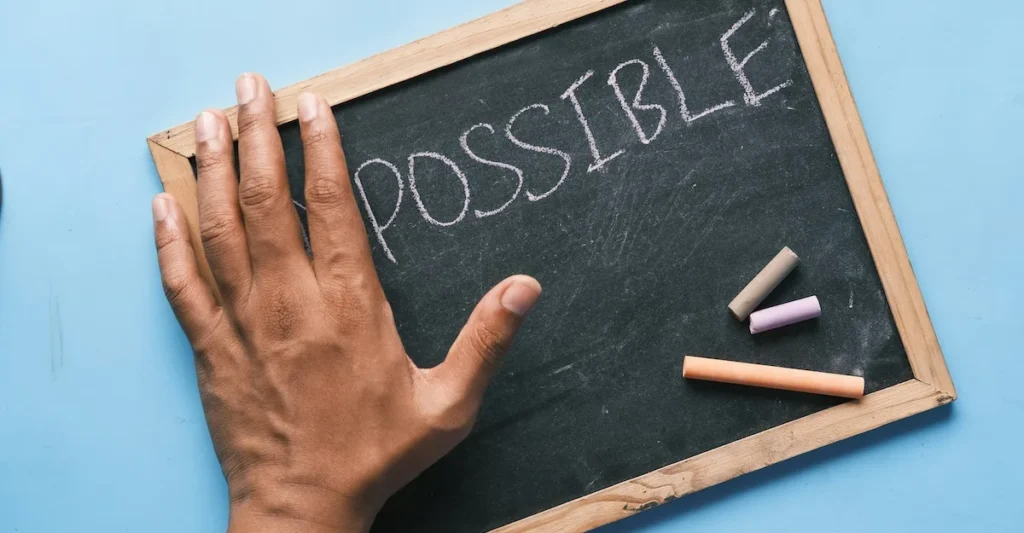
A “possible” relationship is not perfect, nor free of conflict. What distinguishes it is reciprocity. It involves two people who are both emotionally available and willing to engage, even when it is uncomfortable.
For those accustomed to impossible dynamics, such relationships can initially feel unfamiliar. Stability may feel like a lack of intensity. Consistency may feel unremarkable.
But over time and work, the shift is possible. The nervous system begins to settle and the need to chase diminishes. Emotional energy is no longer spent deciphering signals or managing uncertainty. Connection becomes something experienced, rather than pursued.
Love, in this context, is no longer about proving worth. It becomes something shared between two people who already experience themselves as worthy of it.
A Different Kind of Choice
Ultimately, impossible relationships are not only about the people we choose, they are about us and the beliefs we carry into those choices, and this is important to realise. How our self -perception influences how people begin to see us.
To leave such a relationship is not simply to reject another person. It is to begin choosing oneself differently, to have a different kind of self-perception.
It is the movement from enduring to evaluating, from hoping to recognising, from proving to allowing. It is the act of self-love.
And while that shift is neither quick nor easy, it marks the beginning of a different relational landscape, one in which love is no longer scarce, conditional, or uncertain, but possible.
FAQ
What causes low self-esteem in relationships?
Low self-esteem often develops through early experiences where love, attention, or approval felt inconsistent or conditional. Over time, this can create the belief that love must be earned rather than freely received. Difficult relationships, criticism, rejection, or emotional neglect later in life can reinforce these feelings further.
What are signs of low self-esteem in relationships?
Common signs of low self-esteem in relationships include:
- Constant need for reassurance
- Fear of rejection or abandonment
- Overthinking messages or behaviour
- Difficulty setting boundaries
- Accepting emotional inconsistency
- Prioritising the other person’s needs over your own
- Staying in one-sided or emotionally painful relationships
How does low self esteem in relationships affect the way you receive love and affection?
Low self-esteem can make it hard to fully accept love and affection. Compliments may feel undeserved, care may be questioned, and reassurance may not feel lasting. Instead of feeling safe, affection can trigger doubt and a constant need to confirm that the love is real.
How to deal with low self-esteem in relationships?
Healing low self-esteem begins with recognising unhealthy relational patterns and developing a stronger sense of self-worth outside of external validation. This may involve setting clearer boundaries, expressing needs more openly, and learning to tolerate relationships that are calm, stable, and reciprocal. Therapy can also help explore and change these deeper patterns.